
WATLAS Bird tracking
With WATLAS (Wadden Sea Advanced Tracking and Localisation of Animals in real life Systems) we follow several individual birds of different species in the Dutch Wadden Sea. By investigating where birds go and why, we can identify whether and how they can deal with threats such as sea level rise and habitat changes.
Millions of birds depend on the Wadden Sea that offers relative safety and an abundance of food, such as the shellfish, worms, and shrimp. Some bird species use the Wadden Sea temporarily for breeding or for fuelling long-distance migrations, and others are resident nearly year-round. With WATLAS, we study how birds move with the tide, how individuals differ in where they feed, what they feed on and why, and how long they stay in the Wadden Sea on their migratory journeys.
More information about the WATLAS research project can be found on their project page.
How it works
With WATLAS we track birds using Time-Of-Arrival (TOA) principles, unique tag-IDs for radio transmitters, ground stations with tower-mounted antennas, and central data-processing and storage servers. Radio transmissions sent from each bird attached tag are received by several ground stations. The system uses time-of-arrival estimates to estimate the location of the animal and stores the location in a database. The whole setup, from transmitters in different sizes to the receivers out at sea, was designed and developed specifically for this project by our own technicians from the department of National Marine Facilities.
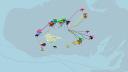
A map of the Wadden Sea showing the locations and trajectories of several birds that carry a WATLAS transmitter (image credit: NIOZ)